
Between records and memories: The COVID-19 Digital Memorial preserves experiences from the pandemic period
During the COVID-19 pandemic, various social groups produced and shared accounts of their experiences in a context marked by uncertainty, loss, and profound changes in daily life. Feelings such as nostalgia, distress, loneliness, grief, and outrage became part of people’s daily lives and were widely documented on social media platforms like Facebook, Instagram, and WhatsApp, forming a vast and diverse digital archive of the period.
In addition to serving as a venue for individual experiences, these platforms have played a central role in bringing collective experiences to light, particularly those of groups historically affected by structural inequalities and social injustices, such as racism, sexism, ethnic prejudice, and other forms of violence. However, despite their relevance as spaces for expression and memory, social media platforms have weaknesses when it comes to the long-term preservation and use of this content, whether due to changes in their management and settings or the unexpected suspension of profiles and files. “The more society comes to operate through digital interfaces—email, WhatsApp, social media—the more ephemeral the evidence of our experience becomes; and paradoxically, the more difficult it becomes to preserve memory, the more necessary it becomes,” says Thiago Nicodemo, coordinator of the project’s digital preservation team.
Cooperation to preserve Brazil’s memory of COVID-19
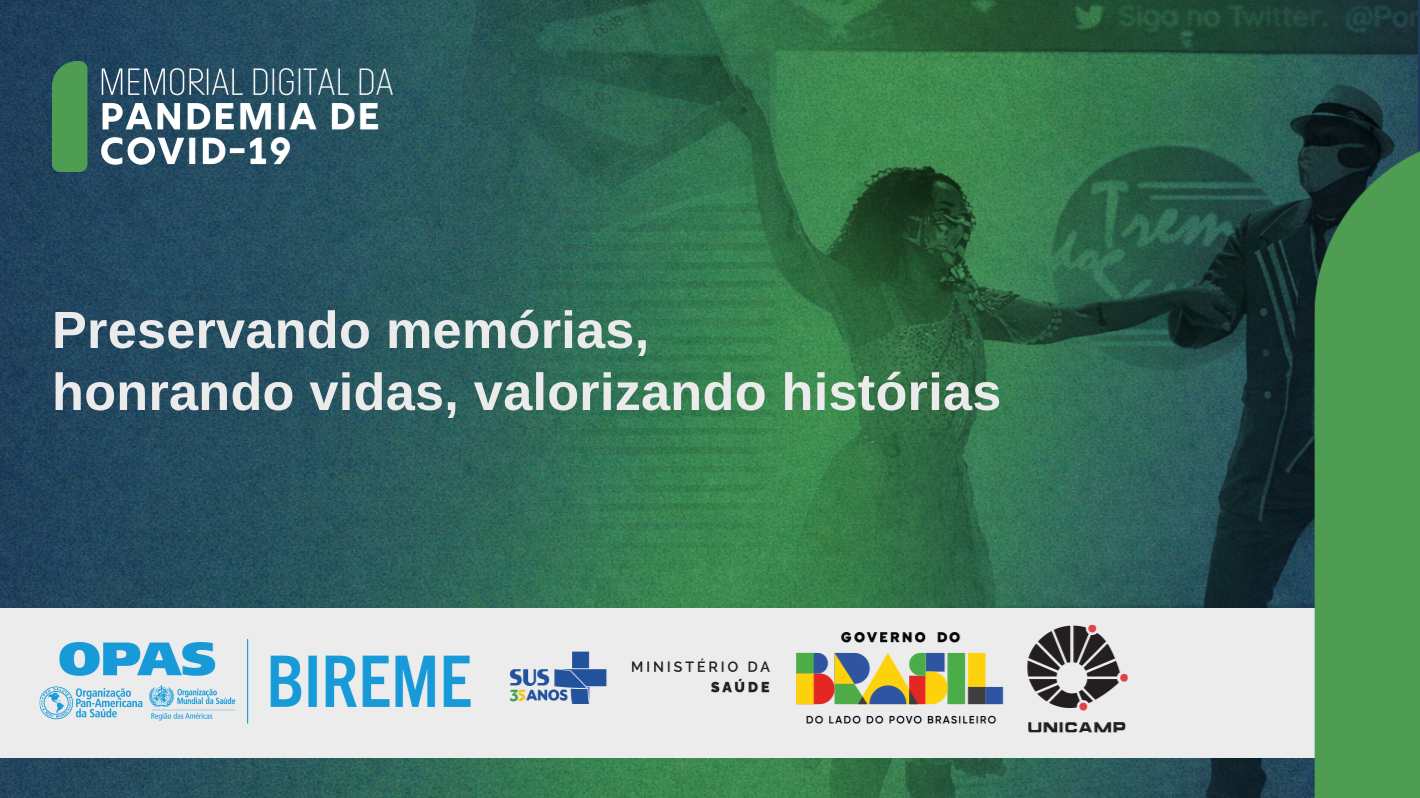
It is in this context that the COVID-19 Pandemic Digital Memorial was created, an initiative of Brazil’s Ministry of Health (MS), carried out through the Ministry of Health’s Cultural Center (CCMS), in partnership with the Pan American Health Organization (PAHO), with technical implementation by the Latin American and Caribbean Center on Health Sciences Information (BIREME/PAHO/WHO), and experts in history and digital preservation from the State University of Campinas (Unicamp).
“The Digital Memorial was designed with the intention of preserving memories of the pandemic in a secure location. Our goal was to create a space where people could upload their records and later access that material quickly and easily,” explains Ian Marino, the project’s curatorial and archival coordinator.
The initiative is guided by the commitment to safeguarding the right to memory and promoting social justice. This is because the Digital Memorial ensures visibility for narratives that have historically been marginalized in the country, such as the experiences documented by indigenous peoples, communities living in areas far from urban centers, and slum dwellers.
According to Nicodemo, “in the Digital Pandemic Memorial, there is no single voice deciding what should be told: what exists is the preservation of what people themselves chose to record. This memory continues to take on new meaning over time, because the meanings society attributes to the trauma experienced also change. For this reason, the memorial is more than an archive: it is a collective tool for elaborating, processing, and confronting the scars of a historical trauma.”
This commitment is reflected in the collections that make up the Digital Memorial. Among them, the Fala Parente project stands out, bringing together accounts produced by Indigenous peoples during the pandemic, highlighting their experiences, care strategies, and forms of resistance within their territories. For Luene dos Santos Karipuna, a member of UNIFAP’s Pet-Indígena project, “participating in the accounts and reading the accounts of my relatives meant being able to share concerns and fears with them, being able to help them vent in some way, because it is not easy to live in the situation we find ourselves in today.” Cleisy Narciso Silva’s experience, meanwhile, as she reflects on a question from her grandmother, highlights the insecurity that permeated different communities: “Will we have to flee again, as we did in the past, when measles broke out in our village?”
The first collections reflect the diversity of the memories preserved
The first collections available in the Digital Memorial expand this diversity of experiences and regions. At the time of its launch, three collections are published in the digital repository: “School in Quarantine: An Anthropological Record of Educational Memories,” featuring accounts from parents, teachers, students, and education professionals; “Lives Matter, Photographs by Erbs Jr.,” consisting of black-and-white photographs taken by photojournalist and historian Carlos Erbs Jr.; and “Speak Up, Relatives! COVID-19 Has Arrived Among Us,” featuring one hundred written accounts by leaders, nurses, students, teachers, elders, and young people from the Apalai, Galibi Kalin’a, Galibi-Marworno, Karipuna, Palikur-Arukwayene, Tiriyó, Kaxuyana, and Waiãpi peoples.
The materials include official documents and records produced by the communities in multimedia formats, such as audio, video, and photographs. “Initially, the collection was based on a survey of content gathered by the Coronarquivo project, followed by direct contact with the groups responsible for the publications,” says Ian Marino. After discussions and agreements, the project teams collected the materials, responsible for the first deposits in the collection.
Infrastructure for preservation and access
To ensure long-term digital preservation, the Digital Memorial adopts the OAIS model (ISO 14721), an international standard that provides guidelines for the organization and security of digital repositories. It uses two integrated solutions: Archivematica, which enables the ingestion and organization of files, and Tainacan, which provides public access to the documents.
This structure enables groups and individuals interested in donating collections to continue submitting files. It also allows sensitive content to be stored with restricted access, while other content can be made publicly available, as agreed upon with the donors and in accordance with the project’s Preservation Plan.
Next steps: expanding the collection and involving new groups
Following the launch of the Digital Memorial, it is expected that new groups will independently contribute materials, thereby gradually expanding the historical collection.
To learn how to donate documents to the Digital Memorial, interested users can download the Collection Sharing Guide, which provides instructions on the procedures required to complete the donation, and contact the technical teams through the portal on the “Memorial > Share Your Collection” page.
“The more society comes to operate through digital interfaces—email, WhatsApp, social media—the more fleeting the evidence of our experiences becomes; and, paradoxically, the harder it becomes to preserve memory, the more necessary it becomes.”
Thiago Nicodemo, coordinator of the project’s digital preservation team.
“The Digital Memorial was designed to preserve memories of the pandemic in a secure location. Our goal was to create a space where people could upload their records and later access that material quickly and easily.”
Ian Marino, the project’s curatorial and archival coordinator.
Learn more: Digital Memorial of the COVID-19 Pandemic, CCMS/MS, BIREME/PAHO/WHO, PAHO, Unicamp Center for Digital Humanities.